Showing posts with label Sleep. Show all posts

My gut tells me to trust my gut

My gut says: trust your gut!
Is there an optimal strategy for making a big decision?  Should we trust our intuition (our "gut") or should we engage in some methodical, step-wise approach?  You know, writing out the pros and cons.

I care right now because I'm trying to make a big decision: what do I want to do with my life?  Yikes.  So, yeah, I'm interested in learning a bit about how to tackle this.

I stumbled upon research suggesting conscious thought is better in some contexts while intuitive decision-making is better in others.  For example, check out this tidbit on decision-making.  In that example, the conclusion was that experts performed best when they relied on unconscious thinking.  Also, it sounds like expertise became less useful to expert decision-makers when they engaged in a conscious decision making process.

Hmm.  So what does that mean for me?  Here's what my gut tells me to do... When making this very complex decision I will engage in four steps:

1. Collect shit-loads of information - In essence, my goal is to actually become an expert on the topic that relates to the decision.  What are all the variables?  Pros, cons? List 'em out and learn them all.  Gather as much information as possible about the decision and feed it to my brain like some giant super-computer (which is sort of is).  But don't decide immediately.

2. Sleep on it - Next, I let all that information percolate through my nervous system.  It will create new connections and recognize patterns.  I will not be consciously aware of most of this.  Also, getting more sleep will speed the process along and help with fidelity.

3. Repeat as long as possible - Every decision has a timeline.  I will repeat the info-gathering and sleeping steps for as long as possible.  How long can I reasonably delay making the decision?  That may be a decision too, so fold that into the larger decision-making process and keep repeating for as long as is reasonable.

4. Trust my gut - Finally, once I've spent as much time as possible considering all the variables, I will trust my gut.  At the end of that time, my super-computer-like brain will print out a small slip of paper (essentially a fortune cookie) and I will do what it says.

Why does this make sense?  Here's my philosophy: the "conscious" part of our brain is a very tiny part of our brain.  Also, it's evolutionarily new and isn't very good at multitasking.  However, our brain has a lot of processing power that goes on behind the scenes and which contributes to all our decisions and actions.  We ignore all that parallel processing at great risk.

Also, big decisions are very complicated and require an understanding of a lot of moving parts.  While our conscious mind is a shitty multitasker, our brain at-large is great at multitasking (think driving and talking on the phone).  Why not exploit that?

So, that's the plan.  Hopefully it's a good decision...

Week of Sleep

Week of Sleep? Check!
The Week of Sleep worked for me.  I'm being totally serious.  I followed my own good advice and was blown away by the results.  Setting up a relaxing, circadian-cycle-friendly nighttime ritual (and sticking to it) has wired my brain to sleep on command.  Now, when my old-person bed time rolls around, I start to get all blinky-eyed and fuzzy-headed instantaneously.  How about you?

Did you miss the Week of Sleep?  Do you want to take your sleep routine to the next level?  Here's the summary:

Week of Sleep

Day 1: Bed Time - Set the clock.
Day 2: Dim - Let there be dark.
Day 3: Bedtime Snack - The way to sleep is through the stomach.
Day 4: Low Flow - Do something.
Day 5: Passive - Do nothing.
Day 6: Bright - Re-Set the clock.

I don't know if you noticed this (I didn't and I wrote all the posts), but the bedtime routine we've developed seems like something that would work for putting a toddler to bed.  And, now that I think about it, that's a pretty smart way to approach our own sleep habits.  I mean, if this approach works for the creatures with the least amount of self-control (i.e. little kids), then it should work for our inner children too.  Or, should I say, our inner monkeys!

Next week, the Daily Mind Games are going to be paused while your humble author heads to an awesome, geeky conference.  While I'm away, I'd love to get some feedback about future Weeks of Metacognition.  What kinds of topics would you like to see?  I've been thinking about Weeks of: Feedback, Creativity, Interaction, Toughness, or Open-Mindedness.  If you have any preference, please let me know in the comments.  Also, if you have any ideas of your own, I'd love to hear them.  I would love some feedback from my readers about topics of interest.  So, please!  Where we should go from here?

Until then, here's some fun/interesting stuff that's come my way over the last week, enjoy!

Homunky's Hot Hits:

To start, here's a retelling of an allegory/experiment about learned anxiety that I've encountered before.  Does anyone know the source of this?  Is it a real experiment?

Next, we've talked about Flow a lot here at The Happy Homunculus, but here is a great Intro to Flow if you'd like a fresh point of view on the topic.  And, of course, if you haven't read the original, you should do it.  Click the link and buy the book to support Homunky!

As someone interested in improving my performance and, as part of that, my pain tolerance, here is a great summary linking meditation, mindfulness, and improved pain tolerance.  This seems to be totally in line with the Mindfulness, Acceptance, and Commitment model for peak human performance: avoiding negative emotions and sensations is the sign of a beginner, while accepting the negative consequences of a task allows full engagement and eventual mastery.

Finally, on a more serious note, HelpForDepression.com is running a fundraiser in support of the non-profit To Write Love On Her Arms, a group dedicated to improving the lives of people struggling with depression and other mental health challenges.  They would appreciate any form of support. Thanks!

Bright

Up and at 'em sunshine!  The Week of Sleep is almost complete - just one more Daily Mind Game and you've earned your black belt in sleep.  That's not a real thing, by the way. Sorry.  But don't fret, this final challenge has nothing to do with sleeping.  In fact, the goal for today is to become as "awake" as possible.  It's time to reset our clocks.

Passive

I can't sleep!
OK, today's the day: we've dedicated a whole week to crafting the ultimate pre-sleep routine.  We've got all the elements we need to get to sleep faster and stay asleep longer.  However, we actually haven't talked about the most critical step of all: falling asleep.  Our routine prepares us to sleep, but what do we do in that final, critical moment when it's just us and our thoughts?  Well, we actually want to do nothing at all; but that can sometimes be very hard.

Previously on The Happy Homunculus, we tried a series of relaxation challenges during the Week of Relaxation.  On the second day, we went through the exercise of being as "Passive" as possible.  In that post, I argued that the last thing we should try to do when we're trying to relax is to, well, try at all. Phew.  Trying is the most counter-productive thing we can do during relaxation.  Similarly, trying to sleep is a contradiction - trying requires energy, effort and focus.  To sleep, we must let go.

So, today, let's revisit the Passive challenge and apply that mindset in the minutes leading up to sleep.

Passive

Task: Lie passively in bed in the moments leading up to sleep.

Info: Close your eyes and let go. Thoughts will come in and out of your mind - this is fine! But, whenever you find yourself wandering, gently return to a more passive state. The key is to not try but to let go.  If your problem is too much thinking, gently label the process "thinking" and move slowly to observing your breathing or the smoothness of the sheets.  Be mindful of your surroundings as an alternative to thought.  If thoughts keep creeping in, be patient and continue to return to a more passive state.  Finally, if you start to get frustrated with your lack of sleepiness, get up and start your bedtime routine again.  Return to bed when you feel sleepy again.

Goal: Maximize the feeling of passivity.

I find that practicing mindfulness meditations help me develop the state of mind needed to let go.  Check out these great guided meditations from UCLA's Mindfulness Education Program for some tips on how to approach passivity.  Good luck!

Further Reading
- Who needs The Happy Homunculus when we have Yahoo Answers' guide to sleep?
- Listen to the Mayo Clinic: Don't try too hard!
- It's not just me: other people think thinking is over-rated.
- Finally, thinking: bad for sleep and feeling good!

Low Flow

Not a care in the world.
Welcome back to the Week of Sleep...  So far, we've compiled three night-time rituals in an attempt to construct the ultimate sleep-promoting night-time routine.  KAPOW!  To review, we selected a bed time, turned down the lights, and had a snack.  Today, we're going to distract ourselves from all the stress of the day, because nothing kills a good night sleep like an unhappy homunculus.

My main sleep-time woe is a wandering mind.  I'm always thinking about what happened during the day, or what's going to happen tomorrow.  On the one hand, it's good to plan and craft strategy, but why do I always seem to do that when I'm trying to sleep?!  There's nothing that pisses off the Sandman more than some anxiety.

Maybe a state of worry is just the default: when my mind is not occupied with some task, it starts to wander.  If so, we may have to get our attention on something productive to avoid needless worry.  We've covered Flow before here at The Happy Homunuclus, so regular readers should know that getting in the zone is a great way to get into a good mood.  The same strategy can be used pre-sleep: let's get into a flow state to get our mind off all the crap we're dealing with.  However, we want the flow activity we choose to be a low energy one - we don't want to get energized right before sleeping do we?

Low Flow

Task: Complete a low energy flow activity in the 30mins prior to sleep.

Info: What to do? Well, reading is always a good idea - especially if it's a fun, fiction book. But, reading isn't the only option.  You could listen to some chilled out tunes, or knit if that's your thing.  You could do some easy crossword puzzles of sudoku.  You could flip through some pleasant photos or sketch.  Choose something that is just barely engaging, but far from stressful.  You want your mind off your worries, not frustrated by some new challenge right before bed.  Choose wisely!  The one thing I wouldn't do?  Watch TV.

Goal: Increase sleepiness with your flow activity.

More sleep tidbits:
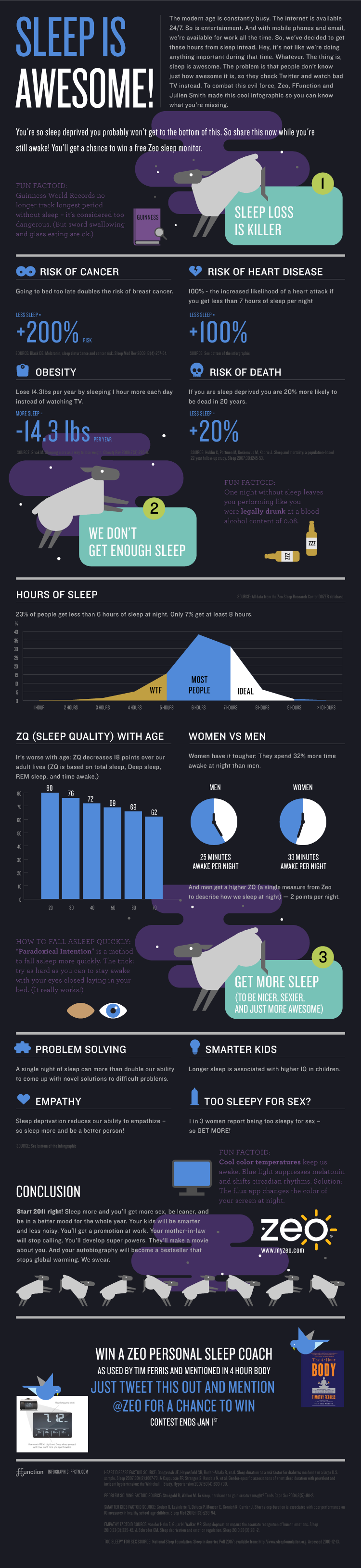
- http://inoveryourhead.net/images/sleep-is-awesome.png
- http://forecast.diabetes.org/magazine/features/the-role-sleep-type-2-diabetes

Bedtime Snack

Food and sleep: I like them both.  My homunculus likes them both.  But, you know what's even better than food and sleep?  Food and sleep at the same time!  There's really nothing like a tasty treat followed by a warm, fuzzy nap, don't you think?  Yet, food and sleep aren't just two, separate pleasures that just happen to go well together.  Oh no, our circadian and gustatory rhythms are intimately related.

Dim

My homunculus is getting sleepy.
Long, long ago, back when our ancestors roamed various grassy lands, things were very different.  We hunted, we gathered, and we didn't have light-bulbs.  No flashlights, no paper lanterns, no halogen desk lamps, no LED keychains. And, if you go back far enough, our ancestors didn't have access to fire either.  So, guess what happened when the sun went down? It got dark.

Modern society is pushing our bodies and brains into new territory.  We have easy access to too many calories, we lead sedentary lifestyles, and we have the ability to create light at will.  For our monkey-like ancestors, light was available when the sun was up, and our circadian rhythms used this powerful, daily cue to determine when to make us sleep and when to get us up.  But, when the sun never sets (just switch on a light), how does our brain know what's up?  It doesn't.

Because of our biology, we need to avoid light when we're trying to sleep.  In addition, in the time preceding sleep, we need to reduce the amount of light in order to signal to our brain that it's sleepy-time.

Dim

Task: Reduce ambient light in your home in the hour preceding your Bed Time.

Info: The less light the better.  The longer you can be in low light prior to sleep, the better. Reduce lights to a minimum.  Also, the dimmer the lights you must use, the better.  Even if you only have one light on, if it's super-bright and right in your face, that's no good.  You want to really set the mood for relaxation and slumber.  Pare down to a few, dim, warm lights and start getting sleepy.  Also, I hate to burst your bubble, but that screen of light you stare at every night before bed (your TV)? Yeah, turn that off.

Goal: Maximize length and extent of low-light conditions prior to sleep.

Beyond just light, in general, the science seems to suggest that blue light in particular seems to be a nasty sleep-killer.  Unfortunately, blue light is a major component of the light pouring out of our TVs and computer-screens.  In fact, the software F.lux can control the amount of blue light produced by your computer, so I recommend you check it out if you must be on your computer late at night.

Additional Resources:
- http://www.webmd.com/sleep-disorders/news/20110119/light-exposure-may-cut-production-of-melatonin
- http://www.marksdailyapple.com/how-light-affects-our-sleep/
- http://stereopsis.com/flux/
- http://ajpregu.physiology.org/content/290/5/R1421.abstract

Bed Time

Hi there, sleepy-head!  Are you all pumped up to get some sleep?  I know it's crazy to get hyped about sleeping, but I can't help it.  My homunculus loves to zonk out.  So, during this Week of Sleep, we're going to pull out all the stops in order to hack our sleep to a whole new level.

Week of Calm

According to Google Image Search,
this is a "Calm Monkey"
Emotions are cool, right?  I mean, they make us feel all weird, sometimes good, sometimes bad.   Occasionally, they come out of nowhere.  They make our bodies do strange stuff: flush, feel tight, feel warm, put butterflies places.  Those are all incredible experiences.  However, that doesn't mean we need to let everyone else in the world know how we're feeling right?

Hence, The Happy Homunculus has sponsored a Week of Calm.  A whole week dedicated to regulating our adult temper-tantrums.  It was a trip!  If you missed out, here it is again:

Week of Calm

Day 1: Feeling - Strange vibrations.
Day 2: Commute of Calm - Drive happy.
Day 3: Cool Off - Get out of there.
Day 4: Poker Face - No tells.
Day 5: Turn the Other Cheek - Empathy, big time.
Day 6: Off the Brakes - Let it out.

Next week, The Happy Homunculus is going to be all about my second favorite thing in the world: sleeping.  I'm going to cobble together a bunch of Daily Mind Games that are going to be soporific to the extreme.  Metacognitive control isn't just about analyzing our own thinking, it's about giving our brain what it needs and craves.  Like some rest.  And I need some rest.

Until then, why not check out the following fun links for some extra credit.  I'd like to make it a weekly habit to share the recent articles that make Homunky the happiest...

Homunky's Hot Hits:

First off, it's always good to get a refresher on what metacognition is all about.  And if that wasn't enough, check out this article for more.

Next up, here is a recent article from the prolific Jonah Leher about making decisions.  It reminded me that it's not always smart to over-think things!  Hungry for more decision-making research?  Here's another article discussing the relative value of emotions and intentional thinking when making decisions. Cool!

Finally, here's a recent piece about memory that reminds me a lot of our discussions during the Week of Memory.  Some good tips there for making concepts stick.